Options
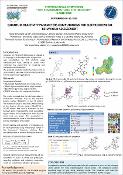
Quantum reactivity parameters computations for electrochemical behavior assessment
Date issued
2020-10
Abstract
Structure of 2,6-bis((E)-2-(thiophen-2-yl)vinyl)-4-(5-isopropyl-3,8-dimethylazulen1-yl)pyridine (LV) was investigated by DFT method using computational tools, aiming to assess their molecular key parameters for reactivity and electrochemical behavior. Energetical levels of frontier molecular orbitals, the Highest Occupied
Molecular Orbital (HOMO) and of the Lowest Unoccupied Molecular Orbital (LUMO) were calculated and used to obtain global reactivity descriptors and an assessment of oxidation and reduction potentials for electrochemical applications. Some studies report correlations between the molecular orbital energies and their
reduction and oxidation potentials obtained from cyclic voltammetry. Consequently, we tried to verify this assumption using Density Functional Theory (DFT) in silico computations on the lowest energy conformer of the above-mentioned structure.
Molecular Orbital (HOMO) and of the Lowest Unoccupied Molecular Orbital (LUMO) were calculated and used to obtain global reactivity descriptors and an assessment of oxidation and reduction potentials for electrochemical applications. Some studies report correlations between the molecular orbital energies and their
reduction and oxidation potentials obtained from cyclic voltammetry. Consequently, we tried to verify this assumption using Density Functional Theory (DFT) in silico computations on the lowest energy conformer of the above-mentioned structure.
Files

Loading...
Name
26.pdf
Description
Abstract
Size
600.66 KB
Format
Adobe PDF
Checksum
(MD5):fffef46bd4ac161bbcb92defb031d891
Loading...
Name
PAMS.9-Quantum.pdf
Description
Poster
Size
1006.28 KB
Format
Adobe PDF
Checksum
(MD5):0d562967fa32c2664276daef322cf0f8